Our Pick: Hometown Hero
Check price →The Hemp THC Ban Hits November 12, 2026: What Dies, What Survives, What to Do
Tucked inside the November 2025 government funding bill is a few pages of text that rewrite what "hemp" legally means — and as it stands now, the new rules take effect November 12, 2026. Most THC gummies and drinks as you know them don't fit the new definition. Here's the calm, plain-speak version: exactly what changes, what stays on the shelf, and the smart moves to make between now and then.
By The Kind Buds Desk · ~9 min read · Updated 2026-06-11
Which one should you buy?
Don't guess. Answer 3 quick questions and we'll match you to your perfect pick in 20 seconds — from this guide's own tested lineup.
Get my pick★ Our Top Pick
Stock Up: Our #1 Gummy
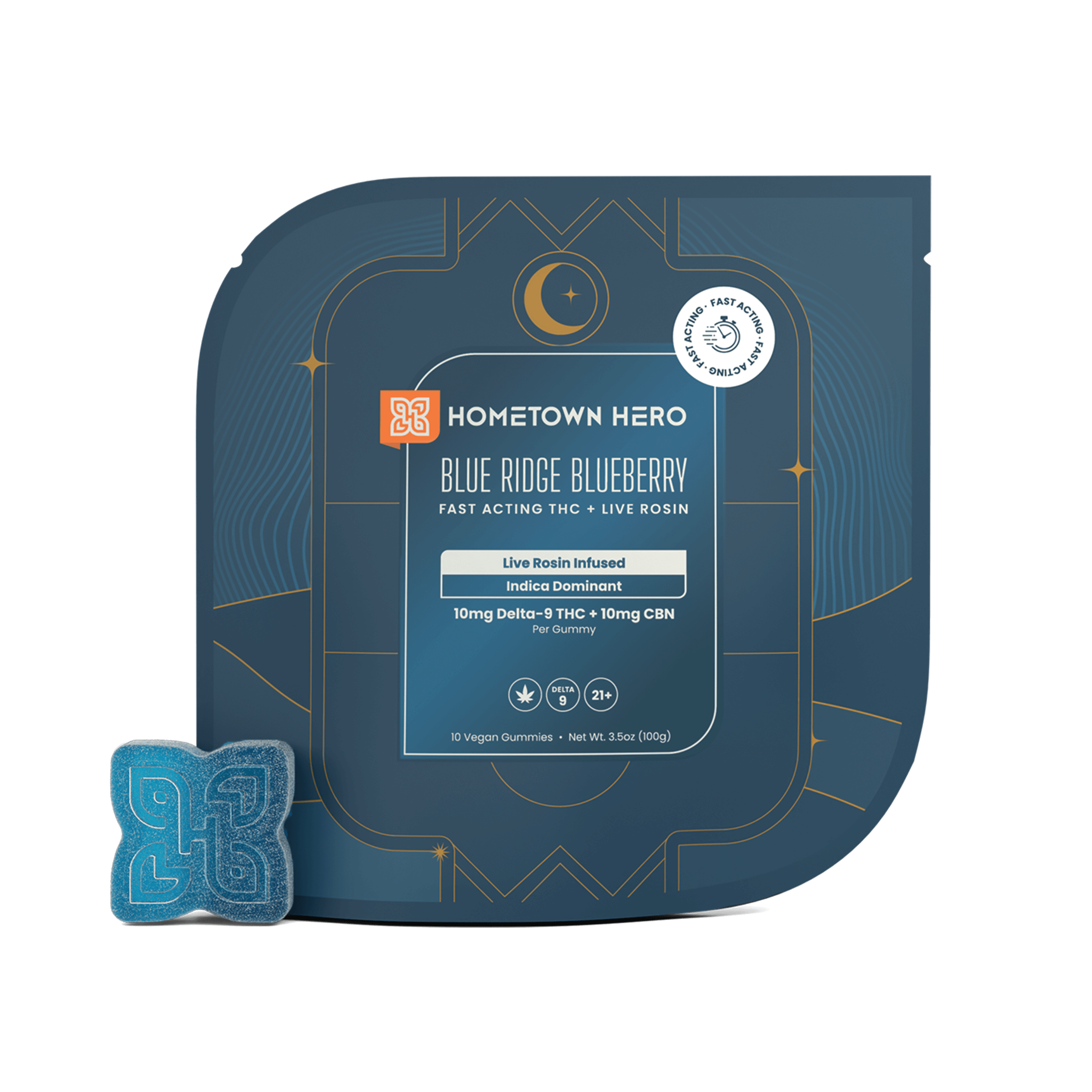
Hometown Hero Blue Ridge Blueberry (D9 + CBN)
Our highest-rated gummy, period — and squarely in the lane the new law ends, so enjoy it while it's here.
Not sure yet? Compare all 4 picks below ↓
Let's skip the scary headlines and just tell you what happened. In November 2025, Congress passed a big government funding bill, and tucked inside it was a provision — a rider — that rewrites the federal definition of hemp. The 2018 Farm Bill measured legality by delta-9 THC only; the new language measures total THC (THCa included) and adds a hard cap of roughly 0.4 milligrams of total THC per container for finished products. For scale: a single ordinary gummy today carries 5 to 10 milligrams. That cap isn't a trim — as it stands now, it takes nearly the entire intoxicating-hemp shelf off the federal menu. Industry groups estimate around 95% of today's hemp cannabinoid products don't fit the new definition.
The date that matters is November 12, 2026. Congress built in a one-year runway, so everything that was legal under the 2018 Farm Bill stays legal until then — which is why your favorite gummy is still on the shelf today and why this guide exists now instead of in a panic next fall. One honest wrinkle: that date could still move. There are bills in Congress to delay, rewrite, or repeal the rider, the White House has pushed to preserve access to non-intoxicating CBD, and the industry is fighting it hard. But the most recent test — the House's 2026 Farm Bill, passed this April — went by without delaying the ban. So we'll treat November 12 as real until the law says otherwise, and we'll say "as it stands now" a lot, because that's the honest phrasing.
Here's our promise, friend to friend: we'll track every twist of this for you — every delay bill, every court fight, every rule change — and keep this guide current, so you never have to read an appropriations rider yourself. Below: a shelf-by-shelf map of what dies and what survives, a short action list (one calm stock-up, three survivors worth meeting now), and plain-English definitions of the terms you'll see in every headline between now and November. The usual fine print, stated plainly: we're your kind buds, not your lawyers — none of this is legal advice, and everything here is for adults 21+.
The short version
- A rider in the November 2025 federal funding bill redefines hemp — and as it stands now, it takes effect November 12, 2026.
- The new rules use a total-THC standard (THCa counts) plus a ~0.4 mg total THC cap per container — which ends delta-8, most delta-9 gummies and drinks, and likely THCa flower as you know them.
- What survives: products under the cap (think THC-free and isolate-based CBD) and everything that was never a cannabinoid at all — kava, kanna, and amanita are untouched.
- State-licensed dispensaries are a separate legal system — this ban is about hemp, not state marijuana programs.
- The date could still move — delay bills and legal challenges are live — but the smart play is to act on the law as written: restock calmly, and get to know your surviving lanes now.
| Shelf | What the law does | As of Nov 12 |
|---|---|---|
| Delta-9 gummies (hemp-derived) | The ~0.4 mg per-container cap is a tiny fraction of a single 5–10 mg gummy | Gone from the federal menu, as currently written |
| Delta-8 (and HHC, THC-O, etc.) | Converted/synthesized cannabinoids are written out of the hemp definition entirely | Gone — the most clearly banned shelf of all |
| THC drinks & seltzers | Same per-container cap — a 5 mg can is ~12x over the line | Gone in current form, as currently written |
| THCa flower | The total-THC standard counts THCa, which is the whole point of THCa flower | Likely gone — it no longer fits the hemp definition |
| CBD | Lives or dies by the cap: zero-THC isolate/broad-spectrum fits; full-spectrum with trace THC may not | THC-free products survive; check full-spectrum labels |
| Kava, kanna, amanita | Not cannabinoids, not hemp — this law simply isn't about them | Completely untouched |
What happens to each shelf — as it stands now
The 20-second quiz
Which one should you actually buy?
Skip the scrolling and the second-guessing — answer a few quick questions and we'll match you to your perfect pick, based on how you'll actually use it.
Quick quiz
Question 1 of 1
What matters most to you?
💡 Good to know
A rider in the November 2025 federal funding bill redefines hemp — and as it stands now, it takes effect November 12, 2026.
01 · Stock Up: Our #1 Gummy
Before Nov 12
Hometown Hero Blue Ridge Blueberry (D9 + CBN)
Our highest-rated gummy, period — and squarely in the lane the new law ends, so enjoy it while it's here.
Pros
- The highest-rated gummy we've ever reviewed — worth knowing while it's here
- Batch-matched COA discipline from the most trustworthy brand in the lane
- A calm one-bag-ahead restock fully covers the transition
- If the ban is delayed, the downside is owning a great gummy early
Cons
- As it stands now, this lane leaves the federal menu November 12, 2026
- Premium pricing, and an evening-only personality
Bottom line: This is the bucket nobody else will be honest about: the stock-up. Blue Ridge Blueberry is the best THC gummy we've ever reviewed — live rosin delta-9 paired with CBN — and as it stands now, products like it leave the federal menu on November 12, 2026. The smart move isn't hoarding; it's a calm, normal restock of something you already use and love, while it's still simply a thing you can buy.
Key details: Current, batch-matched third-party COAs published per product — the house standard at this brand.
Let's define "stock up" like adults, because this bucket attracts nonsense. Stocking up does not mean filling a closet, chasing the countdown, or buying anything you don't already use. It means this: if a delta-9 gummy is genuinely part of your evening routine — and for a lot of our readers, this exact one is — then between now and November 12, it makes sense to buy on your normal rhythm, maybe one bag ahead, instead of discovering in mid-November that the shelf is bare and the resale weirdos have arrived. That's it. That's the whole strategy.
A few honest practicalities for the bucket. Gummies keep, but they don't keep forever — sealed and cool, you're typically looking at many months of peak quality, so buy what you'll actually use by spring, not a doomsday cache. Watch Hometown Hero itself between now and the deadline, too: Texas-based hemp brands have the most at stake here, and serious ones tend to take care of their regulars as transitions approach. And keep perspective — if the delay bills in Congress succeed, the only cost of this strategy is that you own a bag of your favorite gummy slightly early. There are worse outcomes. If you've never tried it and you're curious what the fuss is about, our delta-9 guide has the full review.
- What it is
- Live rosin delta-9 THC + CBN gummies (hemp-derived)
- The bucket
- Stock up — ends with the new federal definition, as written
- The feel
- A true, unhurried evening wind-down
- COA
- Batch-matched third-party COAs posted
Who should buy it: Buy this if a delta-9 gummy is already part of your routine and you want to glide through the transition instead of scrambling — a measured restock of a product you know, from the brand whose lab paperwork we trust most. It's also the right "last first gummy" if you've been meaning to try the category's best while the category still exists in its current form.
What we don't like: The obvious one: as it stands now, this entire lane has an expiration date, so falling newly in love with it comes with a built-in goodbye. Beyond that, the honest knocks are small — it's a premium price per gummy, and the CBN pairing makes it a distinctly evening product, not an anytime one.
02 · Survives: THC-Free CBD


Joy Organics THC-Free CBD Gummies
Zero THC means zero problem with a THC cap — the cleanest way to keep the gummy ritual, as currently written.
Pros
- Untouched by the per-container THC cap, as currently written
- Keeps the exact gummy ritual on legally boring ground
- Non-detect THC — the drug-test-friendly pick on this page
- THC-free by design, with the batch COAs to prove it
Cons
- No high, and it won't pretend otherwise
- Isolate-based calm reads subtler than full-spectrum to some
Bottom line: Here's the quiet logic that makes this pick the safest harbor on the CBD shelf: the new law caps THC per container, and this product's entire identity is containing none. Joy Organics' THC-free gummies keep the format, the ritual, and the calm-body evening — and because there's no THC to count, a THC cap simply has nothing to say about them, as currently written.
Key details: Third-party COAs published per batch; THC-free (non-detect) is the product's whole premise.
The CBD shelf is the one the headlines get most wrong, so let's be precise. CBD itself isn't banned — but the new rules don't care what a product is called, only how much total THC is in the container. That's why the CBD row in our table splits in two. Full-spectrum products, which deliberately keep trace THC in the mix, can stack past ~0.4 mg across a whole jar — putting some of them on the wrong side of the line. But a product built on isolate or broad-spectrum extract, with THC at non-detect, has nothing for the cap to count. Zero is under every cap anyone will ever write.
Set expectations honestly, because we always do: CBD is the calm-body lane, not a replacement high. What many people describe is a settled, even, edge-off feeling — shoulders unknotting, not ceilings moving. If your gummy's job was gentle evening calm, this keeps the exact same ritual on legally boring ground; if its job was the actual high, scroll down to the botanical lanes or revisit the stock-up pick above. There's a bonus for one group in particular: with no THC in the jar, this is also the rare pick that anyone subject to drug testing can use without the asterisk that full-spectrum products carry. For the wider shelf, our CBD gummies guide has the full lineup.
- What it is
- THC-free (non-detect) CBD gummies
- The bucket
- Survives — zero THC means a THC cap has nothing to count
- The feel
- Settled, calm body — no high
- COA
- Batch COAs published; non-detect THC verified
Who should buy it: Buy these if what you want to carry past November is the ritual — a nightly gummy and a settled, calm body — with zero legal suspense attached. It's also the clear pick if you're drug-tested, since non-detect THC means there's nothing to show up, and the right one for anyone who'd rather own a survivor-by-design than reformulated hope.
What we don't like: No high, full stop — anyone hoping CBD secretly fills that gap will be disappointed, and it's kinder to say so here than let the checkout page say it later. Stripping THC to non-detect also costs some of the rounder, fuller character that full-spectrum fans prize. And it's mid-premium pricing for a category with cheaper commodity options.
03 · Survives: Kava

Leilo Kava Tonic
A Pacific root, not a cannabinoid — the hemp ban has literally nothing to do with it.
Pros
- Completely outside the hemp ban — different plant, different rules
- Owns the same unwind moments a gummy or a beer used to
- Disclosed 1,000 mg kava blend per can, testing published
- Clear-headed calm with no high and no morning tax
Cons
- The earthy kava undertone is tamed, not gone
- Craft-beverage pricing for a nightly ritual
Bottom line: If the part of THC you'd miss is the after-work unwind, meet the survivor lane that isn't even in the law's vocabulary. Kava is a Pacific island root — not hemp, not a cannabinoid — so November 12 is just another Thursday for it. Leilo's ready-to-drink tonic, with a 1,000 mg kava blend per can, is the easiest on-ramp: shoulders-down calm, clear head, zero regulatory suspense.
Key details: Third-party lab testing published; kava content disclosed per can.
Here's the most relaxing sentence in this whole guide: the law we've spent two thousand words explaining does not apply to this can. Kava is a root from Fiji, Vanuatu, and Tonga, drunk socially and ceremonially for centuries. Its active compounds — kavalactones — aren't cannabinoids, don't come from hemp, and don't appear anywhere in the rider's text. While the THC shelves get redefined, the kava lane just keeps stocking. That's not a loophole, by the way; it's a different plant entirely, regulated on an entirely different basis. No asterisks needed.
What makes kava the natural pivot for THC's "unwind" job is that it occupies the same moments: the end-of-workday exhale, the Friday night where you want loose but not foggy, the evening where a beer would just make you sluggish. Many people find one can settles them into a relaxed, sociable, clear-headed calm within the half hour — no high, no next-morning tax. At $49.99 for a 12-pack it's priced like craft beverage, about four dollars a can, and the honest note is that kava's earthy undertone is tamed here, not erased. Start with one can and see how it sits with you — and if the lane suits you, our kava drinks guide maps the rest of Leilo's competition.
- What it is
- Ready-to-drink kava tonic (Pacific kava root)
- The bucket
- Survives — not a cannabinoid, not hemp, not in this law
- Per can
- 1,000 mg kava blend
- COA
- Third-party lab testing published
Who should buy it: Buy Leilo if your gummy's real job was the evening unwind and you want that exact feeling from a shelf the ban can't touch. It's the pick for anyone who'd rather pivot once, calmly, to a lane with centuries of history and zero legal suspense — and for the cooler-stocker who wants a grown-up end-of-day drink that isn't beer.
What we don't like: Kava's earthy, faintly peppery undertone never fully disappears, even in a good tonic — expect to acclimate over a can or two, not love it instantly. Craft pricing (~$4/can) adds up for a nightly habit. And it's a beverage lane: if your ritual is specifically gummy-shaped, the amanita pick below or the CBD pick above will fit your hand better.
04 · Survives: Amanita
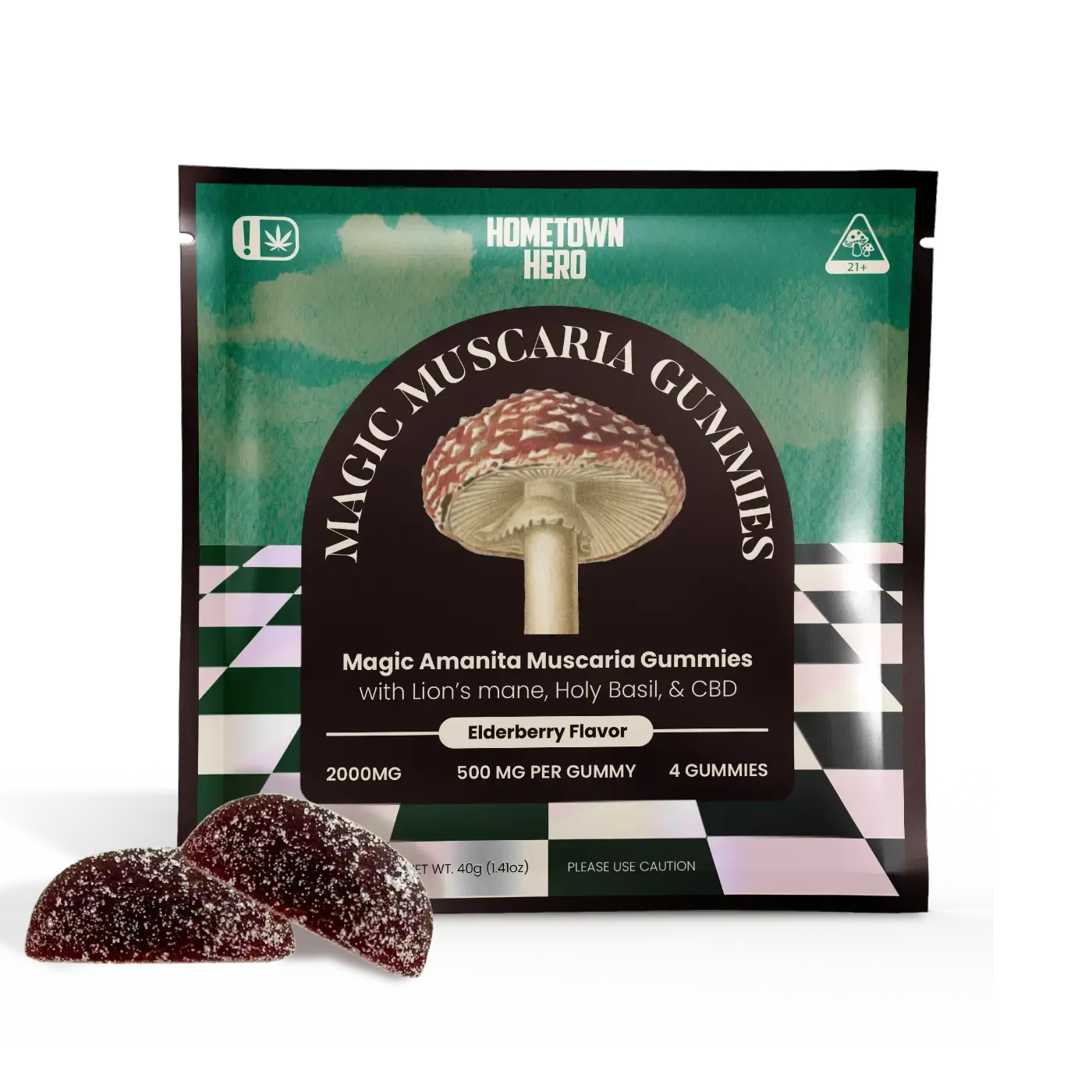
Hometown Hero Magic Muscaria Gummies
A legal mushroom working through muscimol — the bedtime-gummy ritual, on a shelf the ban doesn't touch.
Pros
- The bedtime-gummy ritual, preserved on a ban-proof shelf
- Batch-matched testing from the brand we already trust most
- 500 mg amanita extract with lion's mane and CBD rounding the edges
- Cheapest experiment on this page at $24.99
Cons
- Only 4 gummies per bag — regulars reorder often
- Not legal in every state — check yours
- A distinctive experience that isn't for everyone
Bottom line: The nighttime crowd gets a survivor too. Amanita muscaria works through muscimol — a mushroom compound, not a cannabinoid — so the hemp rider has nothing to say about it. Hometown Hero's gummies pair 500 mg of amanita extract with lion's mane and CBD, keep the bedtime-gummy ritual fully intact, and carry the same batch-matched lab testing as the brand's THC line. At $24.99, it's the cheapest experiment on this page.
Key details: Current, batch-matched third-party COAs published per product — the house standard at this brand.
If the gummy you're worried about losing is the bedtime one, this is your lane. Amanita muscaria — the storybook red-cap mushroom — works through muscimol, a compound that has nothing to do with hemp or cannabinoids, which means the new federal definition of hemp simply doesn't reach it. And let's clear up the usual confusion immediately: amanita is not psilocybin. Psilocybin ("magic mushrooms") remains illegal, and we don't cover products for it. Amanita is a different mushroom, a different compound, a different legal status — lawful in most states, Louisiana being the notable exception — and a much sleepier personality: what many people describe from a measured gummy is dreamy, heavy-lidded, volume-turned-down. Less a high than the day being dimmed to bedtime.
There's a neat symmetry worth noticing: the same Austin brand sits in both of our buckets — the stock-up pick above is theirs, and so is this survivor. That's not a coincidence; it's what a serious hemp company building its own bridge across November looks like, and it means your trust in the paperwork carries over even as the shelf changes. Treat it exactly like a strong nighttime gummy: evenings only, never before driving, and start with half your first time, because amanita is its own experience and a minority of people find it does little for them. At $24.99 for a 4-count, finding out is the cheapest experiment in this guide. The full story of this curious lane lives in our amanita guide.
- What it is
- Amanita muscaria gummies (muscimol — not psilocybin)
- The bucket
- Survives — a mushroom compound, outside the hemp law entirely
- Per gummy
- 500 mg amanita extract + lion's mane + CBD
- COA
- Batch-matched third-party COAs posted
Who should buy it: Buy Magic Muscaria if your THC gummy's job was the nighttime drift and you want the same ritual — one gummy, lights low — from a shelf the ban doesn't reach. It's also the pick for the trust-first buyer: same brand, same batch-matched lab paperwork as our #1 gummy, applied to the survivor lane.
What we don't like: Four gummies a bag makes $24.99 a sampler, not a stockpile — nightly users will reorder often. Amanita's dreamy character genuinely isn't for everyone, so treat bag one as an experiment, not a commitment. And while it's legal in most states (it's not hemp, so this law doesn't apply), it isn't legal in all of them — check yours first.
How we chose
First, the facts. We read the actual coverage — the law-firm analyses, the industry trackers, and the reporting on every delay attempt — rather than the panic posts, and everything in this guide reflects the rider as written today. Where the law is genuinely unsettled (and parts of it are — delay bills are pending and the enforcement picture is still forming), we say "as it stands now" instead of pretending to certainty. When the picture changes, this page changes. That's the deal.
Second, the picks. The action list below is built from products we'd already recommended before this law existed, sorted into two honest buckets: the one stock-up that makes sense if you rely on a THC gummy today, and the survivors — legal lanes the ban doesn't touch, worth meeting before November rather than after. Every pick comes from a brand that publishes real third-party lab results, because our COA rule doesn't take a year off just because the law is changing.
Third, the tone. No stockpile-pressure hype, no countdown-clock theatrics, no health claims — just experiential, plain-speak honesty about what each product is for and why it's in its bucket. And once more, clearly: we're not lawyers, this isn't legal or medical advice, and your own state's rules always apply on top of the federal ones.
Key terms
- Total THC standard
- The new measuring stick. The 2018 Farm Bill counted only delta-9 THC; the new law counts total THC — delta-9 plus THCa (which converts to delta-9 when heated) and the rest of the THC family. It closes the math that made "0.3% delta-9" products intoxicating in practice, and it's the specific line that catches THCa flower.
- The 0.4 mg container cap
- The number doing most of the work. On top of the plant-level standard, finished hemp products are capped at roughly 0.4 milligrams of total THC per container — the whole package, not per serving. A single ordinary gummy is 5–10 mg, so this isn't a trim of the THC shelf; as written, it's the end of it.
- Intoxicating hemp
- Shorthand for the entire category this law targets: hemp-derived products with enough THC to feel — delta-9 gummies and drinks, delta-8 and other converted cannabinoids, THCa flower. It exists because the 2018 Farm Bill legalized a plant and the market discovered the plant's paperwork allowed a buzz. The new rider is Congress un-discovering that.
- 2018 Farm Bill loophole
- The original fine print. The 2018 Farm Bill legalized hemp at under 0.3% delta-9 THC by dry weight — and since a big gummy is mostly gummy, a few milligrams of hemp-derived THC inside it stayed under that percentage. A multibillion-dollar legal THC industry grew in that gap. The November 2025 rider is the loophole's scheduled closing, effective (as it stands now) November 12, 2026.
- Isolate vs. full-spectrum (why isolate survives)
- Full-spectrum CBD keeps the hemp plant's whole compound family, including trace THC — which a per-container cap can add up against. Isolate and broad-spectrum products strip THC to non-detect, and zero THC is under any cap anyone writes. That's the entire survival logic of the CBD shelf in one sentence: the less THC in the jar, the less this law has to say about it.
Questions, answered
Is THC really getting banned?
Hemp-derived THC products as you know them — yes, as it stands now. A rider in the November 2025 federal funding bill redefines hemp using a total-THC standard plus a ~0.4 mg total THC cap per container, effective November 12, 2026. Since one ordinary gummy carries 5–10 mg, virtually the whole intoxicating-hemp shelf (delta-8, most delta-9 gummies and drinks, likely THCa flower) doesn't fit the new definition — industry estimates put it around 95% of today's products. What's not banned: THC-free CBD products under the cap, state-licensed marijuana, and non-cannabinoid botanicals like kava, kanna, and amanita. And note the phrasing we keep using — "as it stands now" — because efforts to change this are genuinely live.
Does this affect dispensaries in legal states?
No. This law rewrites the federal definition of hemp — it doesn't touch state-licensed marijuana programs, which operate under their own state laws. If you live in a state with legal recreational or medical cannabis, your dispensary works the same way on November 13 as it did on November 11. The people affected are those who relied on hemp-derived THC — often because their state doesn't have a licensed program, which is exactly why the hemp shelf mattered in the first place.
Will the November 12 date move?
Honestly: maybe, and nobody serious will promise you either way. There are real efforts to delay or rewrite the ban — bills in Congress, industry pressure, and a White House that has publicly pushed to preserve access to non-intoxicating CBD. But the most recent opportunity, the House's 2026 Farm Bill passed this April, went by without delaying it (amendments to do so were filed, then withdrawn). Our advice is to plan on the law as written and treat any delay as a pleasant surprise. We'll update this guide the moment anything actually changes — that's the promise this page is built on.
What happens to the products I already own?
The law governs what can be produced and sold as hemp going forward — it isn't a knock-on-your-door confiscation program, and products you bought legally before the deadline don't retroactively turn you into a news story. Practically: store gummies sealed and cool (count on many months of peak quality, not years), keep everything away from kids and pets as always, and remember your own state's rules still apply on top of the federal ones. And because we have to say it plainly: we're not lawyers, and this isn't legal advice — it's the common-sense read.
Is CBD banned too?
No — but the headline needs its fine print. CBD as a molecule isn't targeted; the cap counts THC, whatever the label says. THC-free products (isolate or broad-spectrum, non-detect THC) sail under the cap untouched — that's why our CBD pick in this guide is a THC-free one. The complicated case is full-spectrum CBD, which deliberately keeps trace THC: across a whole container, some products can exceed ~0.4 mg, putting them on the wrong side of the line as currently written. If you love a full-spectrum product, watch its label and its brand's announcements between now and November — and know the THC-free version of your ritual is the safe harbor.
What should I do now?
Three calm moves, in order. First, if a THC gummy or drink is part of your routine, restock on your normal rhythm — maybe one bag ahead — rather than panic-buying or waiting for empty shelves; our stock-up pick above is where we'd start. Second, pick your surviving lane while there's no deadline pressure: match the feeling you use THC for (unwind → kava, mood → kanna, sleep → amanita, plain calm → THC-free CBD) and try one new thing, half a serving first. Third, stay informed without doomscrolling — we track every twist of this law and update this guide when reality changes. That's it. No bunkers required.
Keep reading
Legal Alternatives to THC
The full four-lane map of what's legal beyond THC — this guide's sibling and the pivot plan in depth.
The Best Kava Drinks
The unwind lane, lane-deep — every kava drink worth your cooler.
Are Hemp Gummies Legal in Your State?
The state-by-state layer that sits on top of everything federal in this guide.